Monday, November 9, 2015

Labor market in October 2016

http://mam.econoday.com/byshoweventfull.asp?fid=467002&cust=mam&year=2015&lid=0&prev=/byweek.asp#top

2015 Economic Calendar
powered by  econoday logo
U.S. & Intl Recaps   |   Event Definitions   |   Today's Calendar
Employment Situation 
Released On 11/6/2015 8:30:00 AM For Oct, 2015
PriorPrior RevisedConsensusConsensus RangeActual
Nonfarm Payrolls - M/M change142,000 137,000 190,000 150,000  to 240,000 271,000 
Unemployment Rate - Level5.1 %5.0 %4.9 % to 5.1 %5.0 %
Private Payrolls - M/M change118,000 149,000 174,000 140,000  to 230,000 268,000 
Participation Rate - level62.4 %62.4 %
Average Hourly Earnings - M/M change0.0 %0.2 %0.1 % to 0.4 %0.4 %
Av Workweek - All Employees34.5 hrs34.5 hrs34.5 hrs to 34.6 hrs34.5 hrs
Highlights
Bring on that rate hike! Nonfarm payrolls surged 271,000 in October vs expectations for 190,000 and against Econoday's top-end forecast for 240,000. Revisions in prior months are not a factor. The unemployment rate is down 1 tenth at 5.0 percent with average hourly, to underscore all the strength and in a hint of wage inflation, jumping 0.4 percent. Government payrolls, up only 3,000, did not inflate the headline payroll gain as private payrolls rose 268,000.

Among the superlatives, the 271,000 rise for nonfarm payrolls is the strongest since December last year. The 5.0 percent unemployment rate is the lowest since April 2008. The broadly defined U-6 unemployment rate, a favorite of Janet Yellen's, is down 2 tenths to 9.8 percent for the lowest reading since May 2008. The year-on-year rate for average hourly earnings, at plus 2.5 percent, is the strongest since July 2009.

Payrolls in professional & business services surged 78,000 in the month with the subcomponent of temporary help services - considered a leading indicator for future hiring - up a very strong 25,000. Trade & transportation rose 51,000 while retail trade, which is gearing up for the holidays, rose 44,000. Construction spending is strong and payrolls show it, up 31,000 in the month. But the tide failed to lift the export-hit manufacturing sector where payrolls were unable to rise, unchanged in the month following two prior declines.

But there is favorable news on manufacturing as weekly hours in the sector edged higher to 40.7 with overtime also edging up, to 3.3 hours. These point to badly needed strength for industrial production. Other readings include no change for average weekly hours at 34.5, no change in the labor force participation rate at 62.4 percent, but a 1 tenth rise in the employment-to-population ratio to 59.3 percent.

Turning back to payroll revisions, September is revised 5,000 lower to 137,000 with August revised 17,000 higher to 153,000 for a net 12,000 gain. There's still one more employment report to go before the December FOMC - and anything of course can happen - but it seems academic following today's report which points to a pivot higher for an economy where domestic strength is offsetting foreign weakness.
Recent History Of This Indicator
Nonfarm payrolls are expected to rise 190,000 in October which would be a nearly 50,000 increase from September and strong enough to keep expectations alive for a December rate hike. The unemployment rate is expected to slip 1 tenth to 5.0 percent, in what would be another positive for a rate hike. And average hourly earnings are expected to show some pressure, up 0.2 percent vs no change in September.
Definition
The employment situation is a set of labor market indicators based on two separate surveys in this one report. The unemployment rate equals the number of unemployed persons divided by the total number of persons in the labor force, which comes from a survey of 60,000 households (this is called the household survey). Workers are only counted once, no matter how many jobs they have, or whether they are only working part-time. In order to be counted as unemployed, one must be actively looking for work. Other commonly known figures from the Household Survey include the labor supply and discouraged workers.  Why Investors Care
 
[Chart]
During the mature phase of an economic expansion, monthly payrolls gains of 150,000 or so are considered relatively healthy. In the early stages of recovery though, gains are expected to surpass 250,000 per month.
Data Source: Haver Analytics
 
[Chart]
The civilian unemployment rate is a lagging indicator of economic activity. During a recession, many people leave the labor force entirely, so the jobless rate may not increase as much as expected. This means that the jobless rate may continue to increase in the early stages of recovery because more people are returning to the labor force as they believe they will be able to find work. The civilian unemployment rate tends towards greater stability than payroll employment on a monthly basis. It reveals the degree to which labor resources are utilized in the economy.
Data Source: Haver Analytics


Wednesday, November 4, 2015

Consumer holiday spending

http://www.ritholtz.com/blog/2015/10/consumers-holiday-spending-plans/

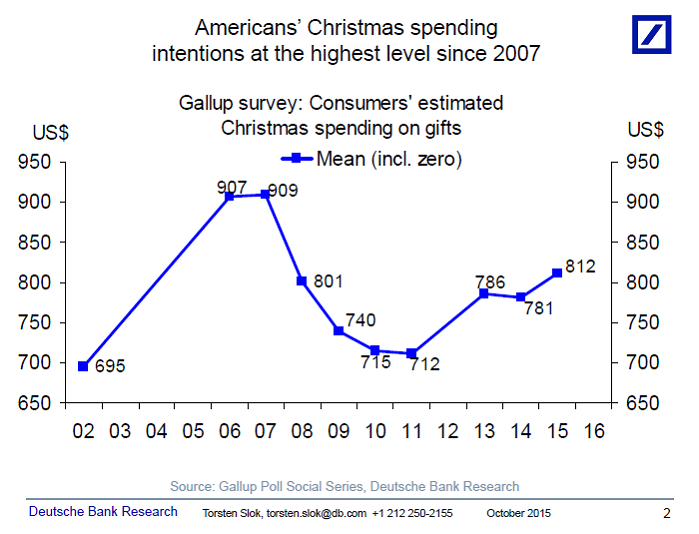
Consumers’ Holiday Spending Plans


Source: Torsten Sløk, Ph.D., Deutsche Bank Research


The Gallup survey (above) was carried out from October 7 to October 11 and shows that US consumer Christmas spending intentions are at the highest level since 2007. Combined with consumer confidence for lower income groups near the highest levels ever, the message for investors is clear: US consumers don’t worry about the things we worry about in financial markets.
Put differently, US consumers don’t seem to worry about the risk of a hard landing in China, the widening of high yield credit spreads, a potential government shutdown, Brazilian corporate debt levels or low bond market liquidity. In other words, next time someone tells you “X is really worrying” you should ask yourself if this is worrying for investors holding assets impacted by X or if X is truly worrying for US consumers, who make up 70% of US GDP.

Wednesday, October 14, 2015

Finding the pulse of the poor

http://www.bostonglobe.com/business/2011/11/27/finding-pulse-poor/ov0E3M1jxYhdMa0hlhQzSI/story.html


Finding the pulse of the poor

Armed with data, an MIT lab offers fresh insight on some of the world’s most vexing problems

Share via e-mail

CAMBRIDGE - It’s no one’s idea of an MIT laboratory: not a beaker or an oscilloscope in sight. But in a wood-paneled suite, on the third floor of a bland, concrete building, researchers are tackling problems as complex and vexing as any in technology, science, or medicine.
This is the Abdul Latif Jameel Poverty Action Lab, or J-PAL, where economists through precise, detailed studies are trying to find ways to alleviate poverty. For nearly a decade, MIT economics professors Esther Duflo, and Abhijit Banerjee, have worked with a global network of researchers to conduct experiments in the world’s poorest places - where families live on less than $1 day - and reached conclusions that are changing the way economists and policy makers think about development in impoverished areas.
JIM DAVIS/GLOBE STAFF
Abhijit Banerjee and Esther Duflo have focused on the world’s poorest.
The findings are contained in their new book, “Poor Economics,’’ which earlier this month won the Financial Times and Goldman Sachs Business Book of the Year Award for “the most compelling insight . . . into modern business issues.’’ In the book, the MIT professors argue that antipoverty policies must be built on evidence from careful, controlled tests that detail how the poor live, act, and react.
For example, Duflo and Banerjee set a goal of increasing immunizations of children, so they divided the people of several villages into two groups. One group was offered free monthly immunizations at a mobile camp; the other was offered the same immunizations, but parents were given one bag of lentils per immunization.
The study concluded that small, nonfinancial incentives not only dramatically increased immunization rates, but also made such programs cost-effective by lowering the cost per child immunized - even considering the price of lentils.
“The prominence and enthusiasm of Duflo and Banerjee have helped make development economics one of the most compelling areas in economics today,’’ said Christopher Udry, an economics professor at Yale University. “They’ve advanced the idea that it’s possible to evaluate small interventions at the community level and they’ve set up a tool kit [of techniques] to make that approach more accessible to economists around the world.’’
Duflo and Banerjee focused their studies on the poorest of the poor when many other economists were concentrating on Wall Street and financial markets. The MIT professors and their network of 59 affiliated professors have conducted about 275 narrowly focused studies in 49 countries to measure how the poor respond to different aid strategies, subjecting antipoverty policies to the same rigor that pharmaceutical researchers use to test new drugs.
Their findings have reached beyond broad generalizations to show that the poor do not always act in ways that conform to the views and programs of well-meaning relief agencies, revealing a portrait of poverty as complex as the movements of financial markets. Why do families without enough to eat choose to buy a television instead of food? Why do antimalaria nets go unused, even when distributed free? Why are bags of healthy grain often not the best response for regions starving for food?
“We don’t think poverty is one problem, it’s 300 separate problems,’’ said Banerjee, in a recent interview with Duflo. “The reason many poverty problems don’t get solved is because everybody wants them to be one problem.’’
Duflo and Banerjee came to the study of global poverty from very different starting points. To Duflo, who grew up in a comfortable, academic family in France, global poverty was a remote abstraction. For Banerjee, abject poverty was as close as the ramshackle houses behind his childhood home in Calcutta. They met at MIT when Duflo, as a student, took a course in development economics from Banerjee. After Duflo earned her doctorate in 1999 and joined the MIT faculty, the two founded the Poverty Action Lab in 2003.
Since then Duflo, 39, and Banerjee, 50, have received multiple honors and prizes. In 2010, Duflo was awarded the prestigious John Bates Clark Medal for the best American economist under 40. The year before, she received a MacArthur Fellowship, the so-called genius award.
What inspires their interest in poverty, Banerjee explained, is the idea that the poorest people must deal with different conditions than the rest of the world’s population.
Duflo said the gap in the quality of life between the US middle class and the poor in a country such as Kenya, where annual per capita income is $770, is so startling that it is a moral imperative to try to close it.
“How you can bring that person in Kenya anywhere closer to the quality of life of us, for example, seems like a primordial question,’’ said Duflo. “It’s hard to imagine that there is a more obvious thing to study. Why study anything else?’’
Today, the poverty lab is a global operation. The staff at MIT consists of 29 employees in research, training, policy, and administration. Affiliated professors are scattered around the world, at universities in India, France, Chile, and South Africa.
The budget of the lab was more than $10 million in 2010. Major benefactors include the Bill and Melinda Gates Foundation, William and Flora Hewlett Foundation, Nike, and the John D. and Catherine T. MacArthur Foundation.
As the number of lab studies approaches 300, creating a body of data to help identify effective antipoverty programs,Duflo and Banerjee hope this work will exert a larger influence on policy makers around the world.
It already has. For example, research by lab affiliates showed that school-based deworming, which removes parasites that can harm the health and learning abilities of children, is one of the most cost-effective methods of improving school participation. The evidence from that study helped convince governments and nonprofit development groups in 26 countries to adopt school-based programs that have dewormed - and helped educate - 23 million children.
“Because of the Poverty Lab, we now have a much richer empirical understanding of the effects of antipoverty policies,’’ said Yale’s Udry. “Duflo and Banerjee have advanced the idea that economists can say very specific things about very specific programs to policy makers.’’
Duflo said she believes the lab’s influence will expand as it generates more definitive studies of poverty programs and more hard data on their effectiveness.
“Five years ago, we didn’t have many results to share, but now we have more lessons to discuss,’’ she said. “Come back in two years, and we’ll have even more to say.’’
D.C. Denison can be reached at denison@globe.com.

US Supreme Court rejects Paul Allen's interval licensing patent appeal

http://www.cnbc.com/2015/10/05/us-supreme-court-rejects-paul-allens-interval-licensing-patent-appeal.html

US Supreme Court rejects Paul Allen's interval licensing patent appeal

4
COMMENTSJoin the Discussion
The U.S. Supreme Court on Monday rejected a bid by Microsoft co-founder Paul Allen to revive several patent claims against AOL, Apple,Google, and Yahoo over software pop-up notifications.
The Supreme Court left in place a September 2014 ruling by the U.S. Court of Appeals for the Federal Circuit in Washington. The court mostly upheld a decision by a district court judge who had ruled that the defendants had not infringed upon Interval's patents.
Paul Allen
Getty Images
Paul Allen
The patents, held by Allen's Interval Licensing, relate to the pop-ups that computer and smartphone users regularly see.
Interval Licensing is the patent-licensing arm of a Silicon Valley research entity that Allen financed, Interval Research Corp, which shut down in 2000.
Interval Licensing sued the tech companies in 2010, accusing them of infringing upon four of its patents, although only two became the subject of the appeal. It said they infringed upon the patents through products and software that use pop-up notifications, court documents said.
Allen and partner David Liddle founded Interval Research in 1992. It employed more than 110 scientists and engineers and was granted 300 patents during its existence, according to court documents.
AOL is part of Verizon Communications.
The case is Interval Licensing v. AOL Inc, U.S. Supreme Court, No. 14-1362.

Economic news - CNNMoney.com